
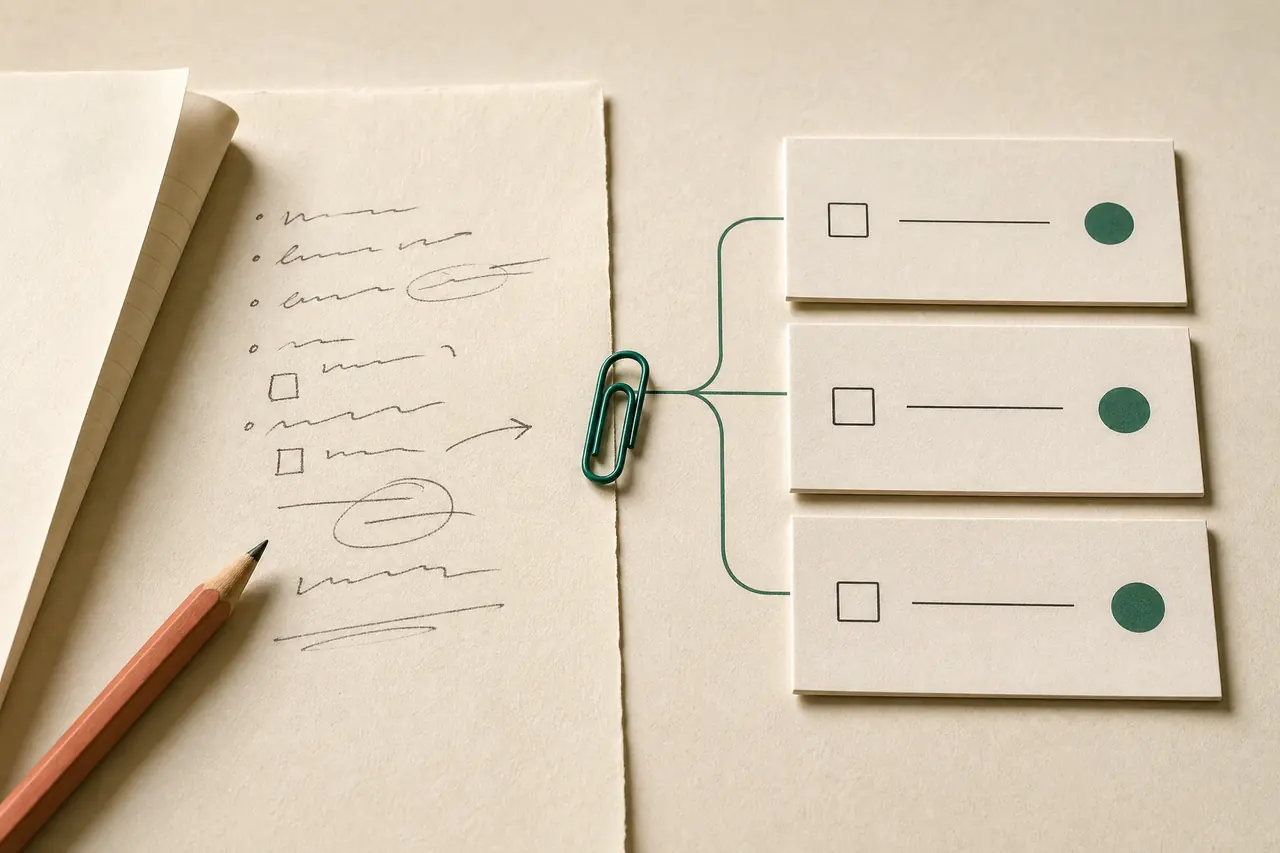
This guide gives you a reusable starting pattern. It is designed to help you see the work more clearly; it is not a substitute for judgment, source checking, or responsibility for the result.
Prepare the inputs before you ask for output.
The model only sees what you give it. Spend a few minutes naming the reader, desired result, and uncertain information. This makes a first draft easier to assess and reduces the need for decorative rewriting later.
Give the task a useful brief.
Convert these meeting notes into an action list.

Notes: [paste notes]

Create a table with: action, owner, due date, supporting context, and confidence. Keep a separate section for decisions and unresolved questions. If an owner or date is not stated, write “Unassigned” or “Not stated”; do not guess. End by listing the three details I should confirm with the group.
Replace every bracketed field with your real context. Read the output before reuse.
Four steps that keep the result usable.
- 1
Capture enough context to distinguish an idea from a decision.
- 2
Ask the model to preserve uncertainty instead of filling gaps.
- 3
Review the output while the meeting is fresh.
- 4
Store the confirmed list where the team tracks work.
Separate the four things meetings produce
Good notes distinguish discussion, decisions, actions, and open questions. A conversation can contain all four in the same paragraph. AI can sort them, but a participant still needs to confirm that sorting.
Make ambiguity visible
If someone said “we should look into it” but did not volunteer, the note should say it is unassigned. This protects the team from the fiction that every spoken idea became a commitment.
Close the loop quickly
Send a compact draft while participants can correct it from memory. A one-line confirmation request is enough: “Please reply if an owner, decision, or due date is wrong.”
A worked example: a sprint review
In a sprint review, someone says “the export job should be finished by Thursday” and a developer says “I can look at it”. Without a record, those are two different commitments. The action list should say what task, which owner, which date, and which discussion it came from. If Thursday was a hope rather than a plan, label the due date as unconfirmed so the team does not plan around it.
Protect against the tidy list
A list where every row has an owner and a date can look complete and still be wrong. Check whether each row came from a stated commitment or from an inference the model made. The safest list keeps a short context column and marks anything inferred, so the team confirms the gaps rather than trusting the table.
Run a human check.
- Does every action have an explicit owner or an “Unassigned” label?
- Are decisions separated from ideas merely discussed?
- Are dates copied exactly rather than inferred?
- Has the list been confirmed by participants?
AI is strongest here when it makes missing information, structure, and options easier to see. The moment an output becomes a claim, commitment, or decision, bring a person back into the loop.